Outdoor festivals thrive on the open-air freedom that makes music and art come alive. But with that freedom comes one of a festival producer’s greatest adversaries: wind. A gentle breeze can quickly escalate into a dangerous gust that turns tents, trusses, and stage roofs into potential hazards. Around the world, there have been sobering reminders of wind’s destructive power at festivals – from sudden gales toppling stages in Europe and North America to freak storms catching events off guard. These incidents underscore a hard truth: every festival, large or small, must be ready to battle the wind.
Experienced festival organizers treat wind safety as non-negotiable. They plan for worst-case scenarios long before gates open. This article distills decades of hard-earned wisdom on managing structures and wind at festivals. From understanding wind ratings and ballast weights for every structure, to setting clear “hold” and “drop” action triggers, to training crews for gusty conditions – consider this a comprehensive guide to keeping your event structures grounded when the weather is up in the air.
Holistic Best Practices for Temporary Festival Structures
Implementing the best practices for using temporary structures at music festivals goes beyond simply reacting to bad weather; it requires a comprehensive, lifecycle approach to site design and vendor management. Before a single piece of steel is unloaded, experienced producers analyze historical weather patterns and prevailing wind directions to optimize the orientation of stages and large marquees. By positioning the most vulnerable assets—such as massive VIP clearspans or towering main stages—so their narrowest profiles face the dominant wind vectors, you naturally reduce aerodynamic drag. Furthermore, a cornerstone of managing festival structures safely is rigorous vendor vetting. Always mandate that staging and tenting partners provide stamped engineering drawings specific to your site’s topography, rather than relying on generic, off-the-shelf specifications. This proactive strategy ensures that every temporary build is fundamentally integrated into your overarching risk management framework from day one.
When designing your site layout, the deployment of a festival truss system requires specialized attention. Whether you are erecting a massive ground support roof for the main stage, flying heavy line arrays from PA delay towers, or building intricate lighting rigs, these modular aluminum frameworks are the backbone of modern event production. However, because a truss grid is often loaded with heavy, wind-catching production elements like LED video walls and moving lights, its aerodynamic profile changes drastically once fully rigged. Production managers must ensure that the structural engineering calculations account for the total surface area of all flown equipment, not just the bare metal framework.
Turn Fans Into Your Marketing Team
Ticket Fairy's built-in referral rewards system incentivizes attendees to share your event, delivering 15-25% sales boosts and 30x ROI vs paid ads.
Know Your Structures’ Wind Ratings
Every tent, stage roof, LED wall support, or towering truss on your festival site has a limit to how much wind it can withstand. Knowing those wind ratings is step one of safe festival production:
– Obtain Wind Specs from Vendors: Always ask your staging, tent, and structure suppliers for the engineered wind load rating of their equipment. For example, a concert stage roof might be rated to safely handle winds up to 60 mph (97 km/h) when fully secured, but that rating could drop to 40 mph (65 km/h) if you add large banners or sidewalls that act like sails. Likewise, a standard 20m x 20m festival tent might handle around 50–60 mph with proper anchoring, but much less if not secured correctly.
– Identify the Weakest Link: Plan around the most wind-vulnerable structure in your festival. It could be a smaller vendor marquee, an inflatable art piece, or a tall PA delay tower. If one tent is only rated to 30 mph, then your overall wind action plan should treat 30 mph winds as a serious threat for the whole event (more on action triggers below). Either reinforce that structure or be prepared to take it down if winds approach its limit.
– Beware of “Unrated” Gear: Not all structures come with clear documentation. Custom-built art installations, locally rented tents, or homemade decor might not have official wind ratings. A festival producer should err on the side of caution and assume a lower safe wind tolerance for such items. When in doubt, consult a structural engineer to evaluate critical custom pieces – or simplify them so they pose less risk (for instance, use wind-permeable mesh for banners or avoid solid walls).
To give you a baseline, understanding the wind resistance specifications for different types of event structures and tents is crucial for site planning. While exact numbers vary by manufacturer, a heavy-duty clearspan structure (often used for VIP areas or mega-stages) might be engineered to withstand gusts up to 70 mph (112 km/h) when fully enclosed and anchored. Conversely, traditional pole tents or high-peak tension tents typically max out around 50 mph (80 km/h). Meanwhile, freestanding event entry & exit truss systems—frequently clad in heavy sponsor signage—are notoriously vulnerable. Because these gate structures act as massive sails right where crowds bottleneck, their safe operating limits can sometimes be as low as 35 mph (56 km/h) unless heavily ballasted and designed with wind-permeable mesh.
Planning a Festival?
Ticket Fairy's festival ticketing platform handles multi-day passes, RFID wristbands, and complex festival operations.
In short, treat wind limits as gospel. If a structure is rated for 50 mph, that’s not the speed to aim for – it’s the red line not to cross. Mother Nature doesn’t read contracts, so give yourself a safety margin below any stated limit.
When evaluating site vulnerabilities, pay special attention to your primary ingress and egress points. Event entry and exit truss systems often serve a dual purpose: guiding crowd flow and displaying high-visibility sponsor branding. However, because these freestanding arches are typically positioned in wide-open areas without surrounding windbreaks, they face extreme aerodynamic pressure. To mitigate this, experienced production managers insist on using wind-permeable mesh for all overhead signage rather than solid vinyl banners. Additionally, these gateway structures should be engineered with widened base plates, cross-bracing, and dedicated guy-wire anchoring whenever ground conditions allow, ensuring that the very first thing attendees see doesn’t become a liability when a storm front rolls in.
When evaluating stage wind vulnerabilities, production managers must look beyond the primary roof canopy. The aerodynamic behavior of a performance space changes dramatically when you introduce solid backdrops, flanking PA wings, and heavy lighting grids. Managing stage wind effectively requires a dynamic approach: ensuring that scrims are designed with quick-release mechanisms and that video walls can be rapidly lowered to the deck if gusts exceed safe operational thresholds. By treating the stage as a living structure rather than a static build, you can adapt its wind profile in real time as weather conditions evolve.
Ballast and Anchoring: Weight is Your Friend
Knowing a structure’s wind rating is only half the battle – you must also ensure it’s anchored or ballasted to meet that rating. A tent or truss will only perform to spec if it’s secured with the correct amount of weight or stakes. Every structure on your site needs a specific ballast plan:
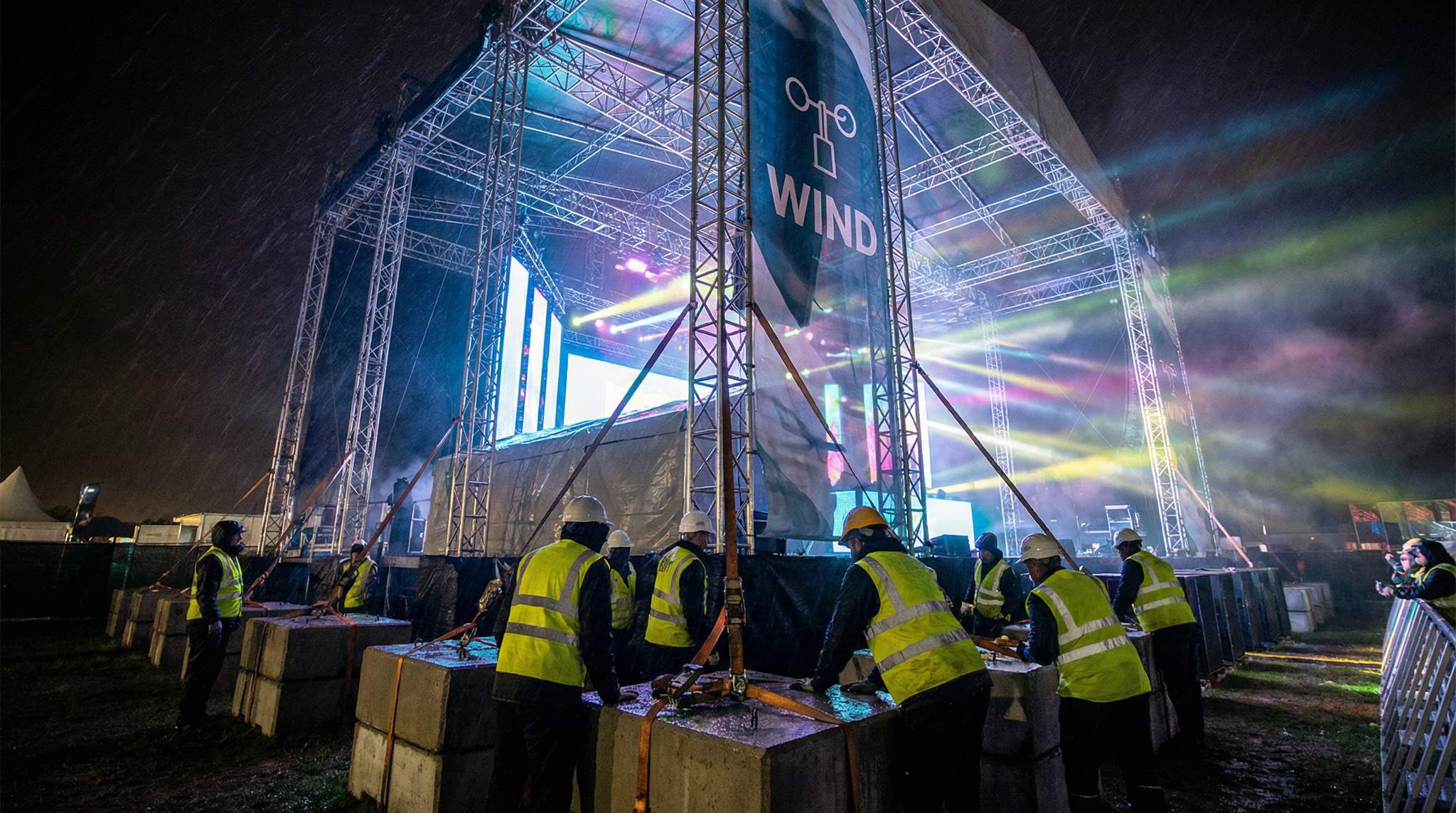
– Match Ballast to Wind Load: Work closely with your tent and staging providers to determine how much weight or how many stakes are required for each structure. This calculation should consider the maximum wind speed you expect or the structure’s rating. For instance, a 10m x 10m free-standing truss arch might require hundreds of kilograms of ballast on each leg to resist a 40–50 mph wind. If you can stake into the ground, use the recommended number and type of stakes (and don’t skip any!). If you’re on asphalt or indoors where staking isn’t possible, arrange for concrete blocks or water barrels of equivalent weight. Never “guess” – use engineering guidelines or manufacturer tables to get it right.
– Plan Logistics for Massive Weights: Don’t underestimate how much ballast weight a festival can require. One large food festival in New York City, for example, needed over 250,000 pounds (113,000 kg) of concrete ballast to secure about 50 mid-sized tents across the site. Moving and placing that much weight takes serious planning – from extra forklifts and trucks to scheduling enough time for ballast setup and strike. Anticipate these needs early so you’re not scrambling for more blocks when a storm is on the radar.
– Balance and Distribute: Ensure ballast is properly distributed and attached. Spreading smaller weights around a tent leg is not as effective as one solid attachment of the full required weight. Use ratchet straps or certified connectors to tie ballast to the structure so it can’t slide or bounce loose. For tall truss towers or stages, place ballast directly below or as per the engineer’s instructions (sometimes weights must be at specific distances for maximum effectiveness). And if one side of a structure is more exposed to wind, don’t cheat by weighting only that side – wind can change direction, so every anchor point should be equally secure.
– Regularly Check Anchors: Throughout the event, periodically inspect all stakes and weights. Vibrations from music and foot traffic can loosen things, and rain can soften ground causing stakes to slip. Make it a routine for your crew to go around tightening ratchet straps and confirming weights haven’t shifted each day (and especially after any windy episode).
Data-Driven Event Marketing
Track ticket sales, demographics, marketing ROI, and social reach in real time. Exportable reports give you the insights to make smarter decisions.
Understanding the technical distinction between an anchor and ballast is critical for site operations. An anchor physically penetrates the ground—such as steel stakes driven into soil or asphalt—providing superior resistance against both uplift and lateral sliding. Ballast, on the other hand, relies entirely on dead weight (like concrete blocks or water IBC totes) to hold a structure down using gravity and surface friction. Whenever ground conditions permit, structural engineers prefer staking, as a properly driven ground anchor offers exponentially more holding power per pound than surface weight. When you are forced to rely solely on deadweight due to venue restrictions (like a pristine stadium field or a concrete plaza), the required mass increases dramatically to compensate for the lack of ground penetration.
When developing a comprehensive festival ballast strategy, production managers must weigh the logistical trade-offs between concrete and water. Concrete blocks (often referred to as mafia blocks) provide immediate, reliable deadweight but require heavy machinery like telehandlers to position, increasing your site’s heavy plant footprint. Conversely, using IBC water totes for festival ballast is highly efficient for transport, as they arrive empty and lightweight. However, this method demands a robust onsite water supply and significant time to fill, plus a sustainable drainage plan for the strike phase. Whichever method you choose, ensure your site’s ground bearing capacity can handle the concentrated loads, especially when placing multi-ton weights on soft grass or sensitive parkland.
Need Festival Funding?
Get the capital you need to book headliners, secure venues, and scale your festival production.
Proper anchoring isn’t a glamorous part of festival production, but it’s absolutely vital. The goal is simple: when the big gusts come, nothing budges. Investing time and resources into ballast – literally, the weighty foundations of your festival – pays off when you avoid shattered tents or collapsed trusses.
“Hold” and “Drop” Triggers: Know When to Pause or Evacuate
One of the smartest things a festival organizer can do is decide ahead of time what actions to take at specific wind speeds. In the heat of the moment, you won’t want a debate over whether to stop a show – you’ll want a clear plan to follow. That’s where wind action triggers come in, often termed “hold” and “drop” thresholds:
– Define a “Hold” Wind Speed: This is the point where you temporarily pause operations and hunker down. For many festivals, a hold might be called when sustained winds reach around 20–25 mph (32–40 km/h) or if wind gusts exceed 30–35 mph. At a “hold,” stage performances can be paused and the audience may be instructed to move out from under large structures but not necessarily leave the venue. Use this time to secure loose items (more on that below) and closely monitor conditions. Essentially, a “hold” is your yellow light – conditions are deteriorating, so you put safety first and prepare for a potential escalation.
– Define a “Drop” Wind Speed: This is the critical threshold where you cease all activities and seek shelter – effectively an evacuation or cancellation until winds subside. A common “drop” trigger might be around 35–40 mph (56–65 km/h) sustained winds or a certain dangerous gust value (say 50 mph (80 km/h) gusts). At this point, you should clear attendees from the stages and tents entirely and direct them to safer open areas or permanent buildings if available. Depending on your structures, “drop” might also mean lowering stage roofs (if your staging system allows it), dropping and stowing video screens, or even intentionally deflating or taking down tents if there’s time. This is your red light – everyone off the stage and potentially off the site if conditions demand.
– Customize Triggers to Your Event: The exact numbers for hold/drop will depend on your specific structures and the environment. A smaller community festival with simple pop-up tents might need to “hold” at lower winds because those tents become hazardous earlier, whereas a big-budget festival with engineered stages could hold longer but still must “drop” before winds exceed the weakest structure’s rating. Use the lowest wind rating on your site as a key reference – you might trigger a “drop” when that limit is close to being hit, even if other structures could theoretically go higher.
– Account for Site-Specific Infrastructure: Beyond your temporary builds, consider permanent or specialized transit mechanisms if your venue utilizes them. For example, alpine music events must strictly monitor ski lift wind limits, as gondolas and chairlifts often face mandatory shutdowns at sustained speeds of 35–40 mph. If your attendees rely on these systems to evacuate a mountain stage, your “drop” trigger must be activated well before the lifts are forced to close.
– Use Reliable Wind Monitoring: You can’t enforce triggers if you don’t know the wind speed in real time. Equip your site with anemometers (wind speed meters) at key locations – ideally at the top of stages or on open-field poles where winds hit hardest. Many festival safety teams now use electronic wind sensors with alarms. For example, if winds hit your pre-set trigger, an alert can ping the safety officer’s radio or even automatically announce an evacuation. (Be sure to test these systems; one major festival had an automatic high-wind alarm that caused confusion when it wasn’t clearly communicated it was stage-specific!). Whether automated or manual, assign someone to watch weather reports and the onsite wind readings constantly when gusts are forecast.
– Clearly Communicate the Plan: It’s not enough for leadership to know the hold/drop triggers – your whole crew needs to know them too. Discuss the wind action plan during pre-event briefings. For instance, “If we announce a wind hold, all tech crews stop and secure gear, and gate staff pause entry. If we call a wind drop, immediately help guide attendees to exit areas calmly.” Rehearse the communication phrases you’ll use for attendees so there’s no ambiguity. Terms like “wind hold” or “weather evacuation” should be predefined and included in your emergency announcements. A well-orchestrated wind response can actually impress local officials and attendees by showing how organized and safety-conscious you are.
By planning these triggers in advance, you remove the guesswork and hesitation when fast-moving storm fronts loom. It’s a tough call to stop a festival, even temporarily – but it’s far better to pause or evacuate proactively than to react after a structure has already blown over. Minutes matter when high winds are inbound, so make the call decisively according to your established thresholds.
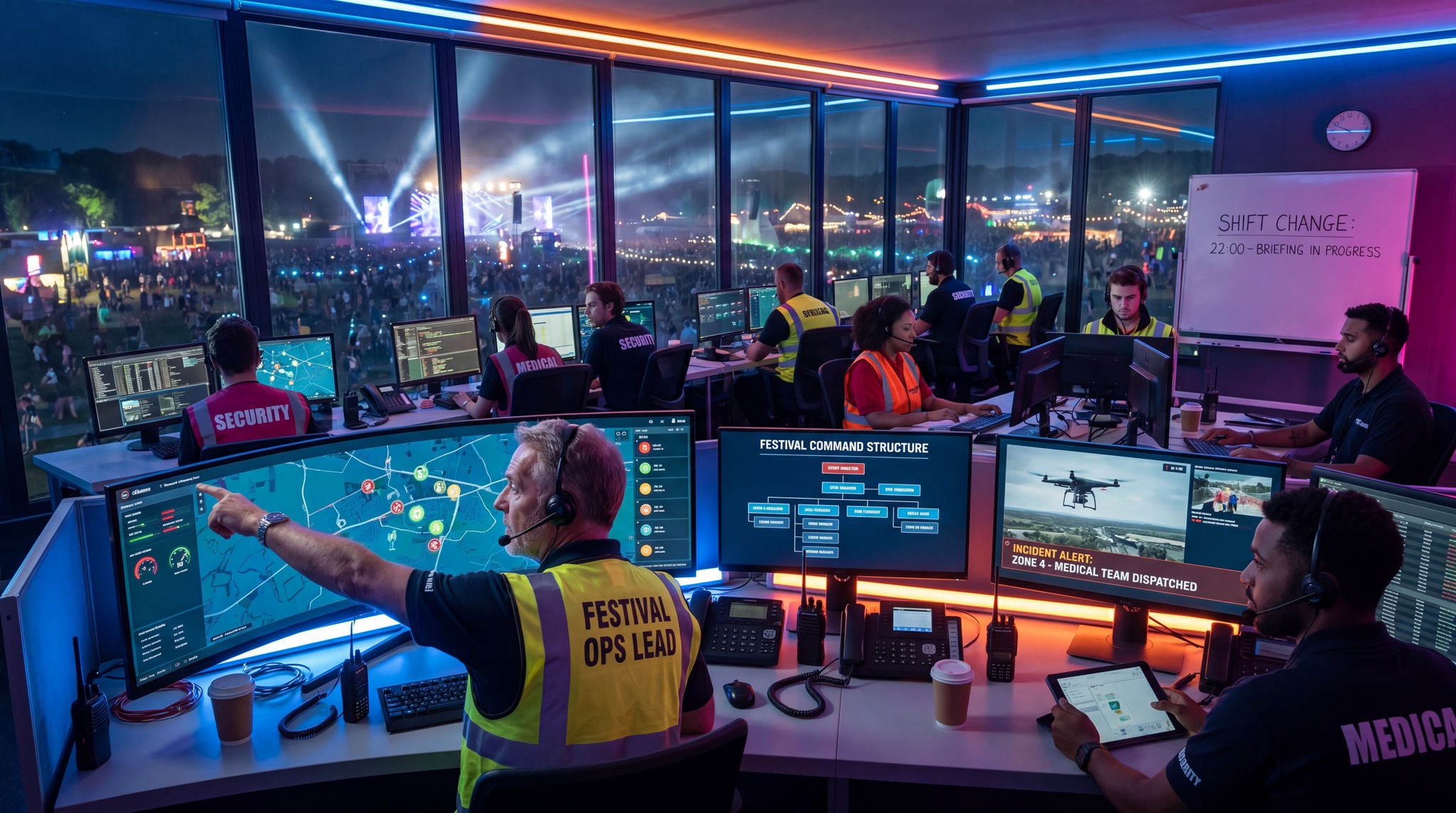
When dealing with unpredictable festival wind patterns across a massive footprint, relying on a single anemometer at front-of-house is no longer sufficient. The best wireless wind monitoring systems for multi-stage festivals utilize a mesh network of ultrasonic sensors placed at the apex of every major stage roof, VIP clearspan, and delay tower. These advanced setups feed real-time, localized gust data back to a centralized event control room dashboard. By deploying multi-point wireless telemetry, production managers can isolate micro-climates on site—allowing them to trigger a localized “hold” on an exposed secondary stage while safely continuing operations at a more sheltered main stage.
Train Your Crew for Gusty Conditions
Having a great plan on paper is one thing; executing it on the ground is another. When sudden gusts hit, every festival crew member should know their role to quickly secure the site. Training your staff and vendors on wind procedures can make the difference between a minor inconvenience and a major disaster:
– Drill the Response Steps: Well before the festival, walk key teams (like stage crew, production managers, and security staff) through a wind emergency scenario. Who is responsible for dropping the stage scrims (the decorative or branded canvas backdrops) or removing tent sidewalls? Make sure everyone knows how to do that quickly. For example, stagehands should practice unclipping and lowering banners or LED screens safely, and tent teams should rehearse rolling up sidewalls or opening tent flaps to let wind pass through.
– Assign “Wind Duties”: Every large structure should have an assigned crew to secure it if high winds strike. Divide your site by zones – one team handles vendor tent rows, another handles the main stage area, another the art installations, etc. When a wind hold is called, these teams fan out to their zones: tie down anything that could fly, double-check all strap tensions, and if instructed, start taking down non-essential elements. This way, nothing is left unattended when it matters most.
– Secure the Sails: Pay special attention to items that can catch wind like a sail. This includes stage backdrops, banners, flags, inflatable decorations, and tent sidewalls. Sidewalls on tents should be quickly removed or pinned up when strong gusts are approaching; otherwise, wind can build up pressure inside and rip the tent or lift it entirely. Likewise, large banners should be taken down or slashed (as a last resort) to prevent them becoming giant sails. Train the crew to know that when you say “secure the sails,” it’s the cue to drop all those wind-catching elements ASAP.
– Protect Equipment and People: In high winds, not only structures but also loose equipment can become projectiles. Instruct crews to stow loose items onstage (like unweighted speaker stands, unsecured lighting fixtures, or miscellaneous gear) and to ensure all road cases, tents, and even portable toilets are braked or weighted. Crew members themselves should be kept safe – no one should climb truss or scaffolding during a wind event, and all non-essential personnel should clear out from areas near big structures once winds are above a safe threshold. Your team’s safety is paramount; remind them that no piece of equipment is worth a life, so if something can’t be secured in time, it’s more important they get to safety and you evacuate the area.
– Cultivate a Safety-First Mindset: Encourage a culture where any crew member can voice concerns if they see a potential wind hazard. Perhaps a stagehand notices a loose truss pin or a tarp dangerously flapping – they should report it or handle it immediately, not assume someone else will. When weather conditions start looking ominous, everyone should automatically kick into a higher alert mode, even before an official hold is called. This proactive attitude comes from training and leadership emphasizing that safety is everyone’s job on site.
When managing high-altitude rigging, strict adherence to a rope access wind speed limit is mandatory. Professional riggers and stagehands working at height are exposed to significantly higher wind loads than ground crews. Industry standards generally dictate that rope access operations should be suspended when sustained winds reach 23 mph (10 m/s), though site-specific risk assessments or local regulations may require even lower thresholds. Always consult your lead rigger and safety officer to establish these operational cut-offs before the build begins, ensuring that no one is caught on a festival structure when a sudden squall hits.
In short, make wind response part of your event’s muscle memory. When storm clouds darken the sky and the radar shows a line of gusts coming, your crew should almost instinctively know what to do — because you’ve prepared them well. That fast, disciplined reaction can save your structures, and more importantly, prevent injuries.
Inspect, Document, and Impress the Officials
It’s not enough to be safe – you also need to prove you’re being safe. Major festivals often must demonstrate their safety measures to local officials or inspectors, especially after high-profile incidents in the past. To satisfy regulatory requirements (and your own peace of mind), keep thorough records of your wind safety efforts:
– Pre-Event Inspections: Have qualified personnel inspect all critical structures once they’re erected. A professional rigger or structural engineer can verify that stages, roofs, and large tents are assembled correctly and all bracings/ballast are in place. They might measure the tension on guy lines or check that all pins are secured. If they find any issue (say, a missing stake or an under-weighted tent leg), fix it before the festival starts. Document these inspections – a simple checklist signed and dated is great evidence that you’ve done due diligence.
– Continuous Checks: As the event goes on, conduct daily morning checks of structures. Look for things like: Are any tent stakes pulling out of the ground? Have water barrels lost weight (water can leak or evaporate)? Are all truss base bolts still tight? This is especially important after any bout of strong wind or heavy rain overnight. Keep a logbook or digital log of these checks as well. It can be as straightforward as “Day 2, 8:00 AM: Main stage roof inspection OK, ballast verified; checked by [Name].”
– Weather Logs: If you have weather monitoring on site, log the wind speeds and conditions at regular intervals or at least record any notable peaks. Many electronic systems do this automatically. These logs can help later to analyze how close you came to triggers or to investigate any issues that arose. They also show officials that you were actively monitoring and responding to Mother Nature.
– Incident Reports: If something does happen – a minor collapse of a shade structure, for instance – document it in an incident report. Detail what fell, what the wind conditions were, and how you responded. This helps improve future plans and shows transparency. It’s far better that you report a small issue and how you solved it than an official finds out and thinks you were trying to hide it.
– Be Permit-Ready: Often local authorities (city engineers, fire marshals, etc.) will want to review your structural plans and wind procedures before granting event permits. Keep all your relevant documents in a ready-to-go package. This might include: engineering drawings and certifications for stages/tents, proof of insurance that covers weather-related incidents, your written wind action plan with hold/drop triggers, and logs of any safety trainings you did with staff. When you can pull out a binder (or a well-organized PDF) with all this information on request, it builds confidence with officials. It says “we’re on top of this” more than any verbal assurance can.
Remember, regulatory officials and safety inspectors are not your adversaries – they’re partners in keeping the public safe. By rigorously inspecting and documenting everything related to structure safety and wind, you not only protect your festival-goers and staff, you also protect your event’s reputation and legal standing. In the event that a freak windstorm does cause damage, being able to show that you took all reasonable precautions is crucial.
Conclusion: Respect the Wind, Earn the Rewards
A festival producer can control many aspects of an event, but the weather will always have the final say. Rather than gambling on a forecast, the best festival producers prepare for the worst and stay vigilant. High winds may never hit your festival – and hopefully they don’t – but having a robust plan for structures and wind is like insurance: you hope you won’t need it, but it’s indispensable when you do.
By specifying wind ratings and ballast plans for every structure, setting clear hold/drop triggers, training your crew to act decisively, and keeping meticulous safety logs, you are stacking the odds in your favor. These efforts can mean the difference between a safe, successful festival and headlines about a disaster. In the end, the audience may never realize the hundreds of extra precautions taken behind the scenes – and that’s okay. When winds howl and nothing flies away, nobody gets hurt, and the show eventually goes on, you’ll know that all that preparation paid off.
Stay safe, stay smart, and never underestimate the power of nature. If you respect the wind, your festival can dance right through the storm.
Frequently Asked Questions
How do I determine wind ratings for festival structures?
Obtain engineered wind load ratings directly from staging and tent suppliers to establish safe limits. Identify the weakest structure on site, such as a vendor marquee rated for only 30 mph, and base the overall wind action plan on that limit. Always assume lower tolerances for custom-built or unrated decor items.
How much ballast is needed for festival tents and trusses?
Ballast requirements depend on specific wind load calculations provided by manufacturers or engineers. For example, a 10m x 10m truss arch may require hundreds of kilograms per leg to resist 40–50 mph winds. Weights must be properly distributed and secured with ratchet straps to prevent sliding during gusts.
What is the difference between a wind hold and a wind drop?
A wind “hold” pauses operations, typically at 20–25 mph sustained winds, allowing crews to secure loose gear while attendees remain onsite. A “drop” triggers a full evacuation or cancellation when winds reach dangerous levels, such as 35–40 mph sustained or 50 mph gusts, requiring immediate shelter seeking.
How should festival crews handle banners and sidewalls during high winds?
Crews must quickly remove or pin up tent sidewalls and lower large banners when strong gusts approach. These items act as sails that catch wind, increasing pressure that can rip tents or topple stages. Reducing this surface area is critical to keeping structures grounded during storms.
How can festivals monitor wind speeds effectively?
Organizers should install anemometers at key locations, such as stage tops or open fields, to measure real-time wind speeds. Electronic sensors with automatic alarms can alert safety officers when pre-set “hold” or “drop” thresholds are reached, ensuring the team can react decisively based on accurate onsite data.
Why is documenting structural inspections important for festivals?
Maintaining logs of pre-event inspections and daily checks proves due diligence to regulatory officials and insurers. Documenting that stakes are tight, ballast is sufficient, and wind speeds were monitored helps protect the event’s legal standing and reputation if a weather-related incident occurs.
What are the wind resistance specifications for different types of event structures and tents?
While exact limits depend on the manufacturer’s engineering, heavy-duty clearspan tents are generally rated for up to 70 mph gusts when fully secured. Standard pole or tension tents usually max out around 50 mph. Freestanding installations, such as event entry & exit truss systems or sponsor activations, often have much lower tolerances—sometimes 35 mph or less—because attached banners act like sails. Festival organizers must obtain official documentation for every specific asset on site.
What is the standard wind speed threshold for tent installation safety?
The standard wind speed threshold for tent installation safety is typically between 15 and 20 mph (24–32 km/h), which is much lower than the maximum rating of a fully secured structure. Temporary structure vendors usually require crews to halt the deployment of vinyl roof panels or the erection of frames if gusts exceed these limits, as loose fabric can become uncontrollable and bend the framework or injure workers.
What is the difference between an anchor and ballast for festival structures?
An anchor physically penetrates the ground (like steel stakes) to provide high resistance against uplift and sliding. Ballast relies on dead weight (such as concrete blocks or water barrels) resting on the surface to hold a structure down via gravity. Engineers generally prefer anchors for their superior holding power, but ballast is essential when venue rules or hard surfaces prohibit staking.
What are the best practices for designing wind-resistant event entry and exit truss systems?
To ensure safety at ingress and egress points, production teams should design freestanding gateway arches with widened base plates and structural cross-bracing. It is critical to replace solid vinyl sponsor banners with wind-permeable mesh to minimize aerodynamic drag. Additionally, these structures must be heavily ballasted or guy-wired to the ground, as their placement in open, high-traffic areas makes them particularly vulnerable to sudden gusts.
What are the core best practices for using temporary structures at music festivals?
The core best practices for using temporary structures at music festivals include vetting vendors for site-specific engineering stamps, orienting stages and tents to minimize exposure to prevailing winds, establishing strict ballast and anchoring protocols, and enforcing predefined weather action triggers. Continuous monitoring and crew training are also essential to ensure these temporary builds remain safe throughout the event.
What is the standard rope access wind speed limit for festival rigging?
Industry standards generally dictate that rope access operations and high-altitude rigging should be suspended when sustained winds reach 23 mph (10 m/s). However, site-specific risk assessments, local regulations, or the specific design of the festival structure may require even lower operational cut-offs to ensure crew safety.
What are the best wireless wind monitoring systems for multi-stage festivals?
The most effective wireless wind monitoring systems for large-scale events utilize a network of ultrasonic anemometers linked via RF or cellular telemetry to a central dashboard. By placing these sensors on every major stage roof and exposed structure, production teams gain real-time, site-wide visibility into localized festival wind conditions, enabling precise, stage-specific safety decisions rather than relying on a single, potentially inaccurate reading.
What are the key safety considerations when deploying a festival truss system?
When erecting a festival truss, organizers must account for the total aerodynamic load of all flown equipment, including LED screens, lighting fixtures, and audio arrays. Because these production elements add significant surface area and weight, the structural engineering calculations must reflect the fully rigged state rather than just the bare aluminum framework. Additionally, ground support towers must be properly leveled, heavily ballasted, and continuously monitored for shifting ground conditions.
How should production teams manage stage wind hazards during a festival?
Managing stage wind hazards requires a dynamic approach to the performance structure’s aerodynamic profile. Production teams must ensure that stage scrims, video walls, and PA wings are equipped with quick-release mechanisms or can be rapidly lowered to the deck. By actively monitoring localized gusts and adjusting these wind-catching elements, organizers can safely reduce the stage’s wind load before thresholds are breached.
What are the most common types of ballast used at festivals?
The most common types of festival ballast are concrete blocks (such as mafia blocks) and IBC water totes. Concrete provides dense, immediate deadweight but requires heavy machinery to move. Water totes are easier to transport empty but require a high-volume onsite water source and significant time to fill. The choice depends on venue logistics, ground bearing capacity, and equipment availability.